

Hyperscalers are racing to secure more compute power to fuel the AI boom; their next frontier is your backyard. Empty office buildings, vacant homes, and underused residential properties are increasingly being viewed as potential sites for small-scale and edge data centers. Leaving you with higher electricity costs, dirty water systems, and increased environmental pressures. Today, we explore how AI infrastructure is reshaping cities, neighborhoods, and energy grids, while also sharing research tools and resources to help you better understand the future of data centers. Stay curious.
📰 AI News and Trends
Data Centers in Your Backyard… Literally.
The Dirt AI leaves behind
The Ugly Opportunity
What about the Law?
🧰 AI Tools - Research
📚 Learning Corner - To prevent or restrict data center construction in your community
📰 AI News and Trends
Data collection experiments by on-demand service platforms have drawn attention to the emerging physical AI ecosystem, with safety experts raising concerns about how such data is collected, processed, and shared
China’s EV exports surged 40% year-on-year in April, further cementing its global dominance of the industry
Huawei Says It Has Workaround to Match Leading Chips by stacking multiple layers of circuits within a single chip and reducing the time it takes to move data among them, they can be ready within 5 years.
Japan’s New Hypersonic Engine Could Make 2-Hour Flights To The US A Reality
Pope Leo XIV warned that artificial intelligence “threatens to normalize an anti-human vision” and turns humans into cogs, and said that the concentration of immense digital power in the hands of a few private actors must be countered.
Data Centers in Your Backyard… Literally.
As I drive through the streets of Southern California, I can't help but notice the number of empty commercial and residential buildings. For-rent, for-lease, and for-sale signs are everywhere. We definitely don't have a homeless issue in SoCal, we have a drug epidemic, and it has made a large part of our population dysfunctional enough to not be able to sustain proper housing, but that’s a different story, a story that I would like to dive deeper into sometime.
The empty buildings make me think of the Data center hurdles that tech behemoths face today. Citizens and certain governments are all against data centers and they are opposing the building of these structures anywhere near humans. Data centers significantly strain and pollute local waters through excessive consumption, chemical discharge, and the thermal pollution of nearby water bodies.
The Dirt AI leaves behind
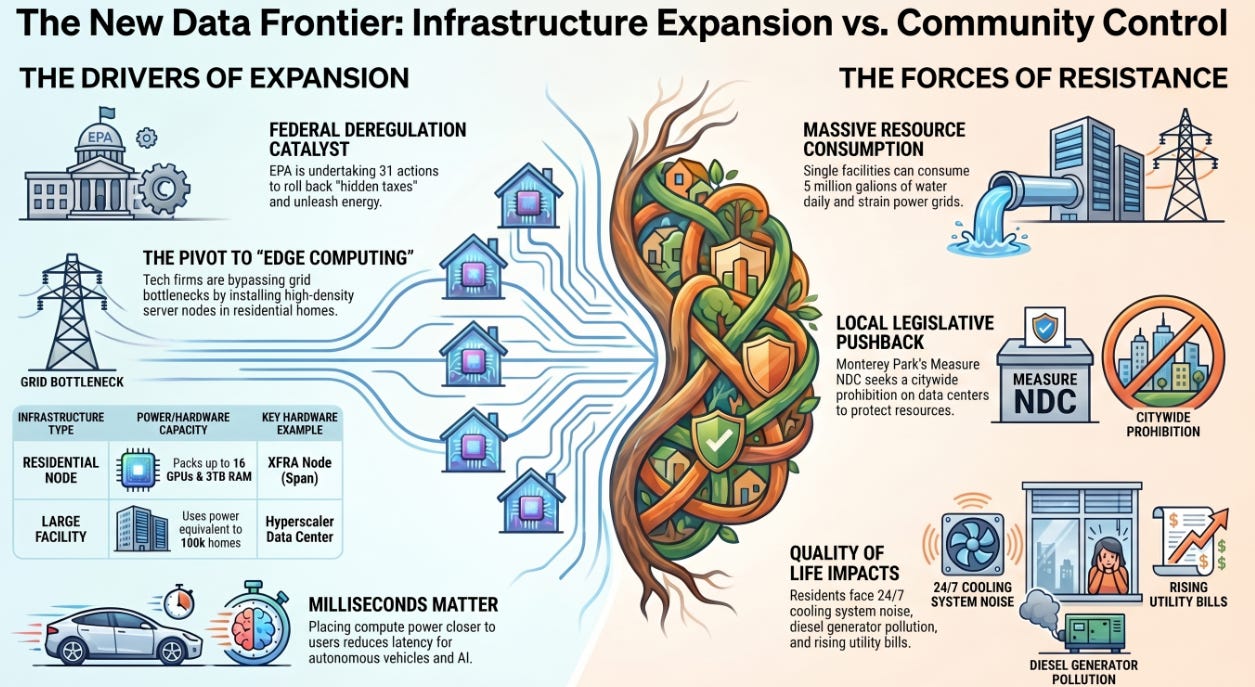
AI data centers are becoming some of the largest consumers of electricity and water in the U.S., with a single modern facility using as much power as 100,000 homes and up to 5 million gallons of water per day. As these facilities expand, homeowners are beginning to feel the impact through rising electricity bills and greater risks of grid instability and summer brownouts. Their constant energy needs are also extending the life of fossil-fuel power plants, slowing clean-energy transitions in many states.
The Ugly Opportunity
All these available real estate locations in SoCal, and any other states, are slowly becoming small Data Centers. That piece of commercial real estate that has been vacant for a few months can easily become the place your device connects next time it searches online. Google just declared that every search will be an AI search, so they are desperate for edge computing and distributed data centers worldwide. This isn’t science fiction. Major homebuilders, startups like NVIDIA, SPAN, which creates a wall battery-like device to be attached outside your home (that can attract thieves), and established data center operators are actively testing and deploying small fractional compute nodes on residential and commercial properties. The infrastructure that powers our AI queries, video streams, and autonomous vehicle decisions is being distributed and moved from the centralized hubs of Northern Virginia and Texas to the edges of neighborhoods, towns, and small cities.
For founders, operators, investors, and real estate professionals, this shift signals a massive opportunity window. But it also surfaces critical operational, regulatory, and valuation challenges that most players haven’t yet solved.
Hyperscalers are land-banking hundreds of acres and locking in multi-gigawatt power agreements across states. But power capacity is the constraint. Placing compute infrastructure closer to end-users reduces latency, for real-time applications like autonomous vehicles, augmented reality, medical diagnostics, and financial trading, milliseconds matter. Edge computing isn’t a new concept, but the scale, cost reduction, and AI advancement have made it suddenly viable at the residential and small commercial level.
What about the Law?
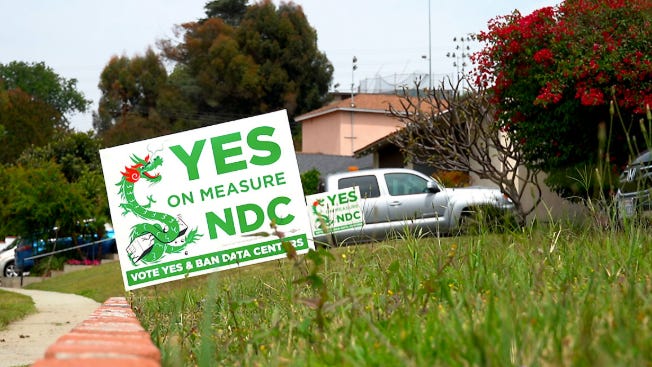
Communities in the nation have become very vocal against Data Center sin the their backyard. Citizens are quickly learning the perils and dangers of them near residences. NDC is a measure to be passed in Monterrey Park, CA, to prohibit the data centers in that community, and many other cities are adopting their own measures and getting organized. The battle will not be easy are no one has deeper pockets than the hyperscalers, and lobbying is something they have mastered, and as we know, everyone has a price. Even the current administration, which is actively unraveling federal limits on PFAS ("forever chemicals") in tap water, has launched historic deregulatory actions that significantly relax environmental protections. Residential zones typically don't permit compute infrastructure. Commercial zones do, but restrictions vary widely as of today. Some jurisdictions require data center facilities to be set back 500+ feet from residential property lines. Rezoning will be the game to play; some will attempt to use it to make data center development more difficult, while some politicians will do the opposite. As the hunger for compute and electricity grows, these data centers in your backyard, literally in your backyard trend will become more controversial.
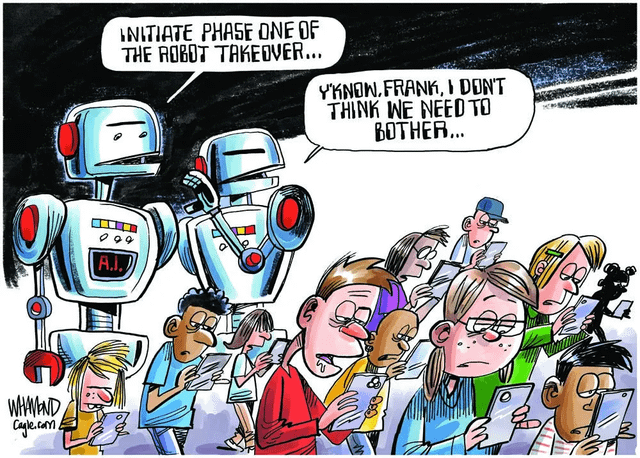
Robots may not take over the world after all… Cause they already id
🧰 AI Tools of The Day
Elicit: An AI research assistant that extracts key claims, methodologies, and sample sizes directly from your search results to help build systematic reviews.
Consensus: An AI search engine that reads millions of research papers and provides direct, evidence-backed answers to specific questions.
Connected Papers: A visual tool that builds graphs of academic papers, allowing you to easily discover related works and the “family tree” of a specific study.
ResearchRabbit: Often called the “Spotify for papers,” this tool visualizes citation networks and sends updates when new papers are published on your saved topics
📚 Learning Corner
To prevent or restrict data center construction in your community
NAACP Stop Dirty Data Centers: Provides resources to track data center proposals, demand transparency, and protect frontline communities from water depletion and air pollution. Use the Report Dirty Data Centers Near You form to log planned sites.
Food & Water Watch: The “Stop Data Centers Now!” campaign offers comprehensive strategies for organizing local petitions, applying pressure to local leaders, and demanding rigorous public votes.
Halt the Harm Network: Offers a co-created toolkit that provides background on the issue and strategic insight into the legal and regulatory interventions available to block bad data center projects.
Community Environmental Defense Services (CEDS): Connects concerned citizens with a nationwide network of attorneys, environmental experts, and engineers to oppose zoning changes and special exceptions.
AlgorithmWatch Guide to Data Centers: A practical European and global guide that details how to check local land use zoning maps, access environmental impact assessments, and fight back against mega-projects