

Flock cameras are doing way more than reading license plates. Those devices hanging on lampposts and traffic lights can learn your driving patterns and schedules, and can also record pedestrians and cyclists and their behavior. The only thing they’ve allegedly been honest about is their lack of facial recognition; everything else is highly questionable. They also hold images and videos for longer than advertised, and share them with more companies than most of us realize.
The more interesting part is that Flock is just one of many surveillance companies running the streets, and far from the most intrusive. We already know we’re being watched. What’s disturbing is the extent of it: the granularity of the data being captured and structured, and the number of companies with access to what we do the moment we step outside. Today we also share how Crusoe has pivoted from building large data centers to building small, modular ones, designed to fly under the radar of political backlash, and run on solar or recycled batteries, avoiding the massive energy demands of their bigger counterparts. Let's dive in.
In today’s issue:
📰 AI News and Trends
The Surveillance Reality Gap
🧰 AI Tools - Surveillance Camera Systems Beyond Flock
📚 Learning Corner
What the Flock is going on?
Are Small Data Centers the Future? Crusoe thinks so…
📰 AI News and Trends
Anthropic says Claude now leads 26% of its AI research work and oversees tens of thousands of active internal agents.
Robots clash in first naval engagement between uncrewed sea drones. There are no humans involved in these conflicts anymore.
All data has value, including the one from your failed startup or any broken enterprise.
Amazon’s Project Mercury will put same-day fulfillment centers (SSDs) “within a 10-mile straight-line radius of 80% of Prime subscribers in the US by 2031
The FAA’s plan to fix air traffic? With a program called SMART $875M worth of AI
Huawei’s Plan to Become China’s Nvidia
OpenAI Just Turned ChatGPT Into an Ad Platform with Agents That Sell for You
Are Small Data Centers the Future?

Crusoe, think so, the startup behind OpenAI’s Abilene, Texas mega-campus, just raised $3.9B at a $30.9B valuation and are throwing a lot of that cash into their modular data centers and hyperscalers can grab a go.
After building some of the largest AI data centers on earth, Crusoe is now betting on small, factory-built “Spark” units it manufactures in Colorado and trucks to wherever power is available. Units are already live in Reno, NV, running on recycled EV batteries and solar.
Training frontier models needs hyperscale clusters. Serving them to users usually doesn’t. As CEO Chase Lochmiller put it, “You don’t actually need an Abilene to do that.” With inference becoming the bulk of AI compute demand, speed-to-deploy and power access now matter more than cluster size.
That’s the real shift in AI infrastructure right now. The bottleneck is moving from chips to power. Developers are pairing projects with on-site gas plants, batteries, and solar, and going modular instead of waiting on massive grid interconnects. Crusoe’s model reflects this, it makes money on leased data centers, rented GPUs, and “managed inference” (tokens), the last of which went from near-zero to a $100M+ annualized run-rate in under a year.
Perplexity is a Crusoe inference customer, and the company still holds 6GW+ under contract, including large campuses still being built with Google. Big and small aren’t competing here; they’re becoming two product lines for two different workloads.
📚 Learning Corner
What the Flock is going on?
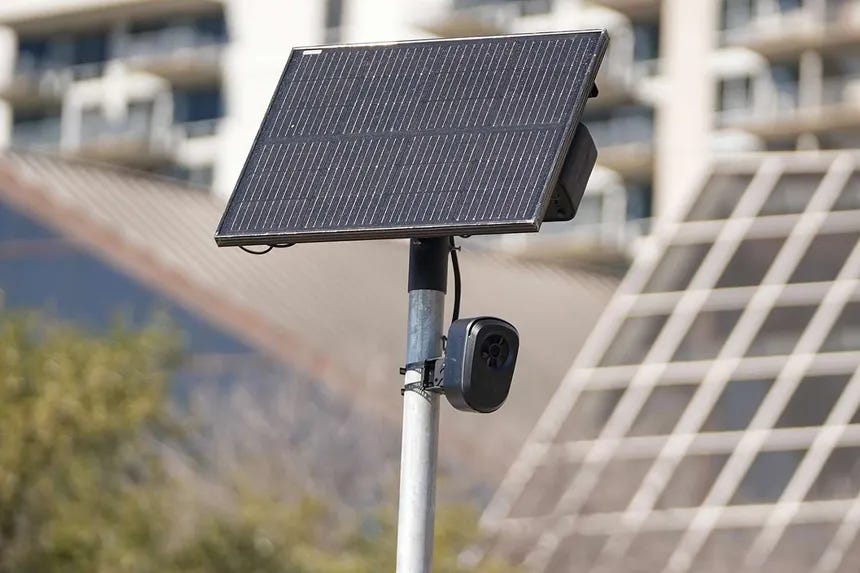
Hackers from a collective calling themselves stegan0gram physically removed a Flock Safety automatic license plate reader camera, extracted its storage, and shared the recovered data with 404 Media and WIRED, offering an unprecedented look inside a system Flock had described as protected by on-device encryption. The hackers found unencrypted partitions on the camera’s Android system, including one containing an encryption key that unlocked stored videos and images; over roughly 21 recorded days, the single camera photographed about 50,200 vehicles and generated 1.6 million images, with the underlying software explicitly detecting people, bicycles, and license plates rather than just vehicles as commonly assumed. Analysis showed the camera’s computer-vision models occasionally misidentified bumper stickers and other graphics as license plates, and while Flock maintains its cameras don’t perform facial recognition, journalists found no evidence of active face-recognition capability beyond Android’s unused default features.
The breach lands amid escalating controversy over Flock’s national camera network, which allows thousands of agencies, including police departments, universities, and even a federal inspector general’s office, to search license-plate data across jurisdictions, and which has previously been linked to lookups performed on behalf of ICE and in a case involving a self-administered abortion. Flock called the camera’s removal illegal and said it had received no vulnerability report through its official disclosure process, while a former police officer turned Flock critic warned that this kind of vigilante hacking risks hardening institutional support for the technology rather than curbing it. The story adds to a broader pattern this year of security researchers and hackers probing surveillance and AI infrastructure, including separate reporting on AI agents being used to hack websites, underscoring growing public and journalistic scrutiny of how automated surveillance systems actually work versus how vendors describe them.
🧰 AI Tools of The Day To be Aware of
Other ALPR/Surveillance Camera Systems Beyond Flock
Axon — Decades-old, multibillion-dollar public safety company (also makes Tasers and body cameras). Its fixed ALPR systems (Outpost, Lightpost) go further than Flock by connecting plates to live video and multi-agency evidence workflows via Axon Fusus. Essentially a full operational surveillance layer, not just a plate log. CEO Rick Smith has publicly said agencies are switching to Axon specifically citing better “controls and privacy” positioning post-Flock backlash.
Motorola Solutions — Long-standing law enforcement tech vendor, offers comparable ALPR products integrated into its broader public-safety ecosystem (radios, CAD systems, video).
Verkada — Originally a commercial/enterprise security camera company that has expanded into government/law enforcement ALPR offerings.
OpenALPR (by Rekor) — Software-based approach that converts existing IP/traffic cameras into LPR-capable devices rather than requiring dedicated hardware; used by both public and private buyers.
Safe Fleet FOCUS H2 — Positioned more for high-traffic sites (airports, ports, military bases) and fixed/mobile/portable deployment variants.
The Surveillance Reality Gap
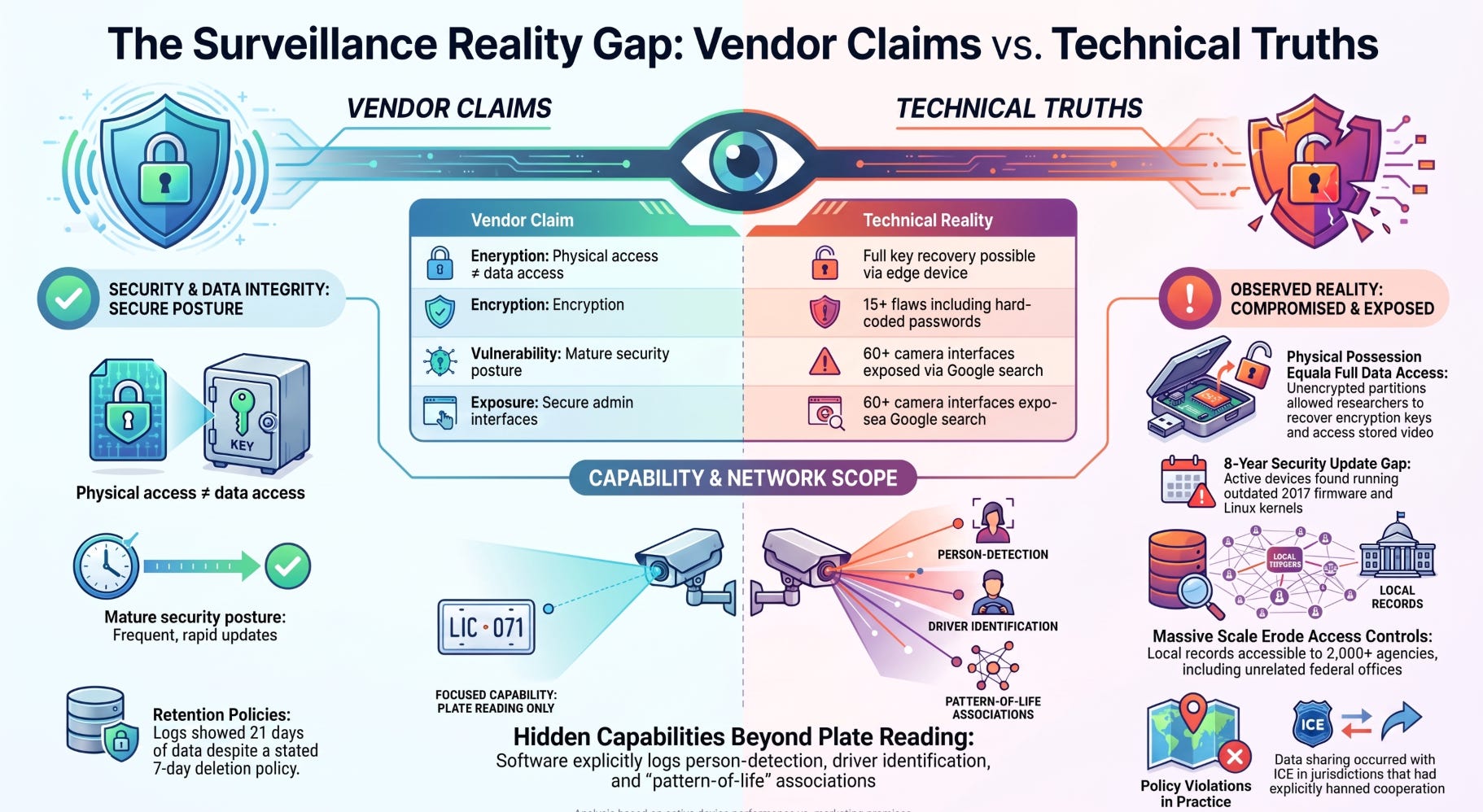
When hackers physically pulled a Flock Safety camera down and cracked its on-device encryption key in September 2026, they exposed more than one company’s flaw, they revealed a consistent pattern across the entire automated surveillance industry: what vendors claim about security, retention, and capability rarely survives independent scrutiny. Flock had told researchers that physical device access wouldn’t yield footage access; the hack proved that false, and further digging found firmware running Android 8.1 from 2017, eight years behind on security patches, alongside 15+ federally logged vulnerabilities, 60+ publicly exposed admin panels found via basic Google searches, and a stated 7-day retention policy contradicted by 21 days of logs recovered from the device. The company markets itself as a “license plate reader,” but the extracted software explicitly detects and scores people, not just plates, and its backend can trace vehicles that repeatedly travel together, a far broader capability than the marketing suggests. The one claim that actually held up: no facial recognition, which matters precisely because it shows vendor claims should be checked one by one rather than trusted or dismissed as a category.
The pattern extends well past Flock. Axon, now positioning itself as the privacy-conscious alternative and picking up agencies switching away from Flock, faces a California class action alleging its Fusus platform operates statewide without the state-mandated privacy policy, plus independent security scans flagging basic web-hygiene gaps despite Axon’s own claims of CJIS-grade encryption and extensive audits. A Syracuse case study found switching from Flock to Axon didn’t produce the contract transparency privacy advocates expected, it just moved which vendor’s paperwork stayed undisclosed.
Motorola and Verkada, now under the same Senate Judiciary subcommittee scrutiny (Senator Hawley invited all four CEOs to testify as of today), have drawn far less independent technical review so far, which reads less like a clean bill of health and more like an attention gap that hasn’t caught up yet, given Flock itself had years of quiet operation before its own disclosure wave hit.
The throughline across every vendor is that security claims tend to be narrow and technically defensible, while the actual points of failure sit entirely outside what marketing copy addresses which are retention enforcement, cross-agency data sprawl, and patch cadence on hardware sitting physically unguarded in public. For anyone evaluating this category, a city weighing a contract, a vendor-diligence process, or an investor sizing up the sector, the working assumption should be that a vendor’s stated security posture describes what they intend to be true, not what an independent teardown will actually find.