

All eyes are on the IPO race. SpaceX, OpenAI, and Anthropic are in a race to get your hard-earned money, while their competitors and the rest of the world watch closely as this unravels. The development of these IPOs will be a huge signal of how the world sees the value, or lack thereof, of AI. By now, we have been hearing about this technology nonstop for the past 3-4 years, but it seems like the world already depends on it, and it kind of does. Some heavy users can’t operate without access to ChatGPT or AI models. Companies are laying off by the thousands with the hopes of replacing humans with AI. Everyone seems to outsource their thinking to an LLM model for almost everything; students are getting A’s again thanks to AI, and the dependence is just getting started. As we move to AI agents where scenarios without humans in the loop are connecting multiple applications via APIs and webhooks, we will start experiencing this new technology as a utility. AI Agents work through workflows, which connect different nodes to execute an action. If the nodes break or APIs do not connect, there will be no Flow in that Work. Are we heading to a world where the work will only flow if we have AI workflows?
📰 AI News and Trends
Sports, AI, and the Algorithm of Fandom.
The Data Is Now the Product
Micro-Betting + Personalization = Behavioral Shift
Where does the Money Flow?
Fanaticism, Quantified
🧰 AI Tools - Check Our AI Guides Repository
📚 Learning Corner - Meta Workforce Academy
📰 AI News and Trends
OpenAI to go public on the heels of SpaceX and Anthropic. Where are you putting your money on?
The new “Siri AI” is rolling out this fall. Alongside a new Google-powered update to Apple’s on-device Foundation Models, as well as tighter integration of all these AI capabilities across Apple’s many operating systems.
Xiaomi, the Chinese tech company mostly known for its phones, cheap electric scooters, and air purifiers, has released an AI model that is allegedly faster than ChatGPT and Claude
Perplexity plans IPO in 2028
World’s first wind-powered underwater data center starts operating in China
Meta Deletes Face-Recognition System From Its Smart Glasses App
JPMorgan, Citi, and Big Banks Plan New Tokenized Deposit System to Answer Crypto
China’s exports surged past analyst expectations last month as the global AI boom fed demand for Chinese chips, EVs, and other high-tech components.
Sports, AI, and the Algorithm of Fandom.
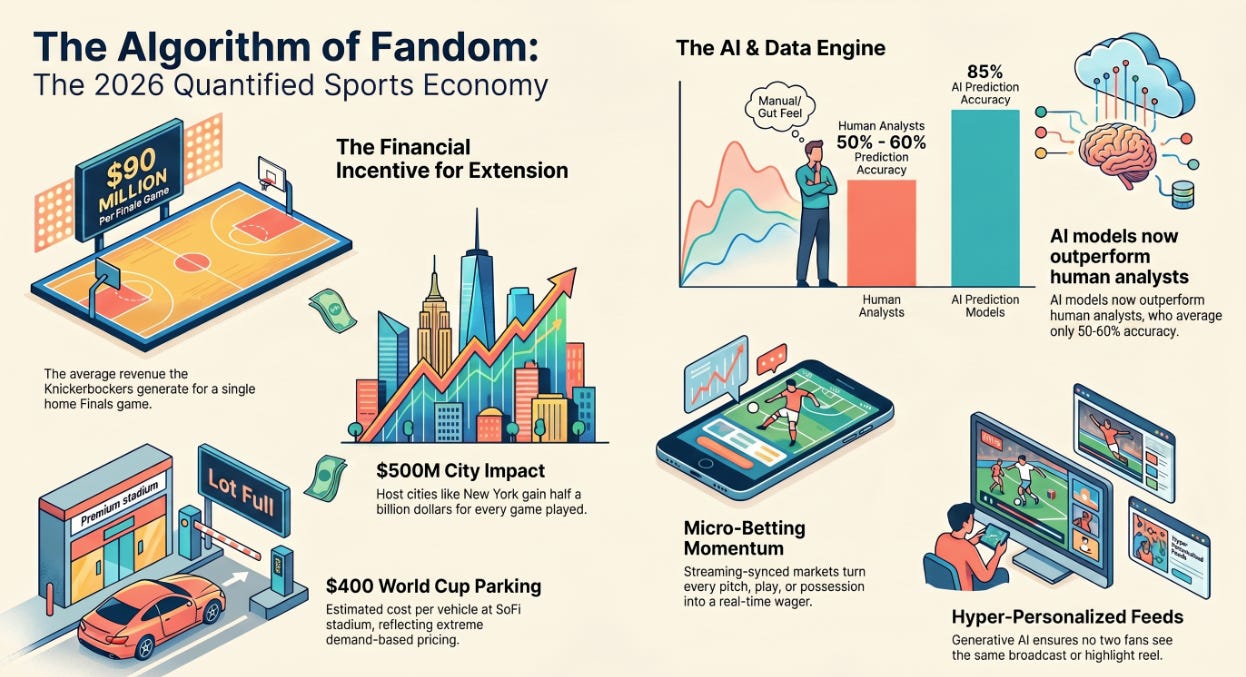
I was watching Game 3 of the NBA Finals in the fourth quarter when it hit me. The team owners, investors, the networks, the French TV networks (Wemby), the refs, and the cities involved, and the fans, literally nobody in this ecosystem wants these series to end.
The Knickerbockers are pulling in ~$90 million per home Finals game. New York City? Half a billion per game. NBA refs average a $200k salary plus $20k per Finals game, and suddenly, a quick sweep becomes a massive financial loss. Meanwhile, the World Cup is quickly approaching. I was talking to a friend of mine who works for LA Metro, and he shared that the parking at SoFi Stadium for World Cup matches is climbing to $400 a vehicle, that’s insaneeee. This isn’t a conspiracy (or is it). I want to believe it’s incentive alignment. The system wants more games, more days, more eyeballs, more transactions. It’s all about the Benjamins…
Now layer on what’s actually changed in 2026: AI-powered prediction markets, real-time personalization, and micro-betting that turns fanaticism into quantifiable engagement. Suddenly, the economics of sports aren’t just about who wins the trophy, but about who can extract the most value from the attention economy while the games unfold.
The Data Is Now the Product
The NBA tracks 29 data points per player across all 29 arenas in real-time. AWS processes millions of data points per game. That data used to stay with teams and broadcasters. Now it flows directly into fan-facing apps, personalized highlight reels, and, critically, betting algorithms.
Platforms tracking 50+ input variables show 28% accuracy improvements in upset predictions vs. human analysts. This matters because it means AI models now achieve 75-85% accuracy in predicting game outcomes, up from 50-60% for traditional methods.
The betting market knows this. Sharp money moves on AI predictions faster than expert takes move online. Your favorite analyst’s gut feel isn’t competing fairly anymore when neural networks trained on decades of play-by-play data can come up with the perfect prediction in seconds all day, every day.
Micro-Betting + Personalization = Behavioral Shift
Here’s where the system gets clever. Streaming-synced micro-markets now offer point-by-point wagering in tennis, pitch-by-pitch in baseball, play-by-play in football, turning every moment into a decision.
We are actively trading on sub-game events in real-time. A momentum shift in the third quarter? Bet it. A key defensive stop? Wager on the next possession. The emotional peak that used to last three seconds now gets monetized. AI-generated market layers can theoretically multiply wagering opportunities around the kind of sudden, high-emotion game events that drive viewer engagement.
And it’s personalized. No two fans see the same broadcast, highlights, or betting suggestions anymore. Generative AI is accelerating hyper-tailored fan feeds, predictive insights, and personalized highlight experiences as critical infrastructure in sports media in 2026.
Engagement gets quantified. Emotional reaction maps to a wager. Wager maps to data about what drives you as a fan. Every data point feeds back into the next personalized experience. The system learns your fanaticism and commercializes it.
Where the Money Flows
Infrastructure: Companies building agentic sports systems. Salesforce just became an Official World Cup 2026 supporter, bringing Agentforce 360 to fan engagement and tournament operations across a 5+ billion viewer audience.
Prediction & Personalization: SpeedLabs raised $6.5M to build AI-powered momentum markets that create new wagers from in-game moments in summer 2026. This is just the beginning. Every sportsbook needs a personalization engine now. Every platform needs real-time odds automation.
Data Ownership: The leagues and broadcasters are realizing their real product isn’t the game, it’s the data the game generates. Whoever owns the personalization layer owns the fan relationship.
Fanaticism, Quantified
The 2026 sports season is the moment fanaticism became a measurable, tradeable, personalized commodity. We are not fans anymore. We are a data source, a prediction node, and a micro-transaction waiting to happen.
The games will be longer. The betting will be more granular. The personalization will be eerily accurate. The cities, teams, refs, and platforms will all optimize for engagement length, not sporting merit.
All we can do is watch or not. But the algorithm knows exactly how to make it irresistible.
🧰 AI Tools of The Day
Check Our AI Guides Repository
📚 Learning Corner
Meta Workforce Academy
Meta is redirecting resources toward its AI ambitions. After laying off thousands of employees, the company has expanded efforts to analyze workplace tasks to improve AI systems while investing billions in new data centers. Its newest workforce academy is focused on training technicians and operators to build and manage the infrastructure powering future AI models, signaling that data centers have become a strategic priority for the company.