

California continues to defy AI federal regulations with state-level regulations, anti-bias protocols, and other safeguards. This may be needed as more businesses are now running several AI apps that may misinterpret your data, hallucinate, or break safety rules, harming customers. Now more than 45% of businesses use AI regularly, and the other half will adopt AI very soon. Let’s dive in. Stay Curious.
California Defies New AI Safety Regulations
🧰 AI Tools - 20 Essential AI Tools for Small Business
The Tipping Point is that 46.6% of Businesses Now Pay for AI
Subscribe today and get 60% off for a year, free access to our 1,500+ AI tools database, and a complimentary 30-minute personalized consulting session to help you supercharge your AI strategy. Act now, as it expires in 3 days…
📰 AI News and Trends
Yahoo has launched Scout, an AI-powered answer engine now available to its 250 million U.S. users, aiming to simplify online search and deliver more personal results tied to each person’s interests.
ChatGPT app store falters six months after launch.
15% of Americans say they’d be willing to work for an AI boss, according to a new poll. Would you trade your manager for a chatbot?
Mistral, the French LLM company, raises $830M to build Nvidia-powered AI centers in Europe.
Other Tech News
Speaking to students at Harvard University yesterday, Fed Chair Jerome Powell said that although energy prices are rising due to the war in Iran
Nvidia’s PE sinks to a seven-year low as war and AI angst weigh
Bill Ackman says it’s one of the best times in a long time to buy quality stocks
Quantum technology firms race to market as the industry sees ‘inflection point.’
Pete Hegseth’s broker attempted to make defense investments before the Iran war
New rule could fast-track SpaceX IPO for Nasdaq index inclusion
California Defies New AI Safety Regulations
California Governor Gavin Newsom has signed a major executive order establishing strict new standards for artificial intelligence companies, setting up a direct legal and political confrontation with the Trump administration’s deregulation agenda.
The Key Details:
State-Level Guardrails: Companies seeking contracts with the State of California must now prove their models prevent the distribution of child sexual abuse material (CSAM) and violent pornography.
Anti-Bias Protections: AI firms will be required to demonstrate how they avoid “harmful bias” and prevent the use of their tech for unlawful discrimination, detention, or surveillance.
Content Transparency: The order directs the state to develop best practices for “watermarking” AI-generated or manipulated images and videos to combat misinformation.
Federal Friction: This move directly defies President Trump’s December executive order, which discouraged “cumbersome” state rules in favor of a national policy focused on rapid innovation. The White House has already tasked the DOJ with challenging state-level AI regulations.
Why It Matters: As the “birthplace of innovation,” California is using its massive purchasing power to force ethical standards on the industry, even as the federal government threatens litigation to keep the sector deregulated.
🧰 AI Tools of The Day
AI Top 20 Tools Playbook 2026 - 20 Essential Tools for Small Business
The 20 essential AI tools for small businesses in 2026, curated and written by our team. Just honest, opinionated takes on the tools that actually move the needle.
The Tipping Point is that 46.6% of Businesses Now Pay for AI
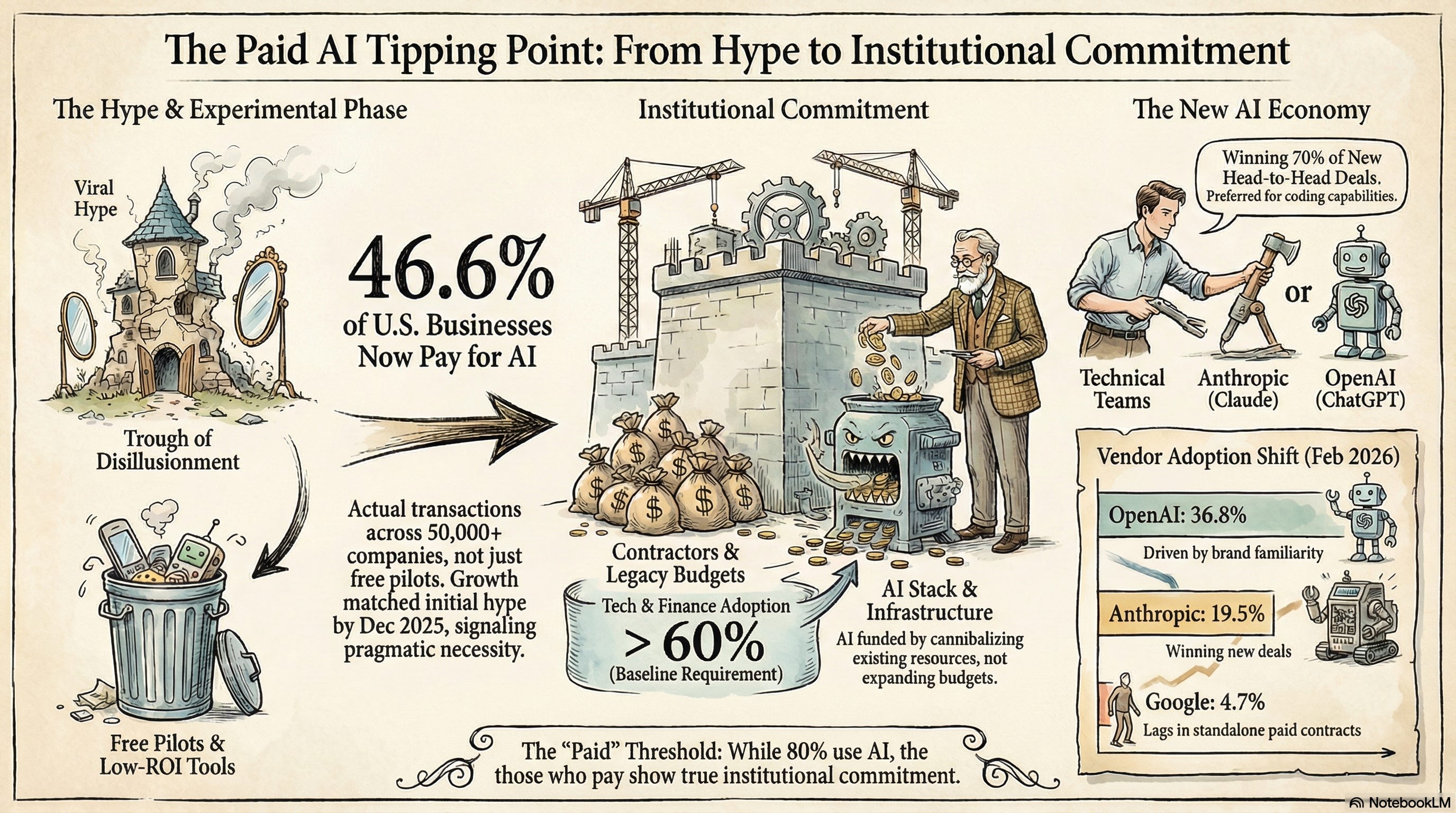
In December 2025, “46.6% of U.S. businesses paid for AI services,” a 1.6 percentage point jump from November that marked the largest month-over-month spike since April 2025. Unlike survey data, this figure from Ramp's AI Index (tracking actual transactions across 50,000+ companies) captures real money moving to vendors, not just experimental pilots, but committed infrastructure spending.
April 2025 previously held the record for monthly growth, driven by early "AI agent" hype and viral image generation tools. That December 2025 matched this velocity after months of Gartner's "trough of disillusionment" suggests businesses moved past hype into pragmatic, necessity-driven adoption.
The Shifting Vendor Landscape
OpenAI drove December's growth, reversing a two-month decline to hit 36.8% adoption. But the strategic story is Anthropic: growing from 16.7% to 19.5% by February 2026, winning 70% of new head-to-head deals against OpenAI, a complete reversal from 2025. Technical teams increasingly prefer Claude's coding capabilities, while OpenAI benefits from consumer familiarity with ChatGPT. Google lags at 4.7%, though this excludes Gemini bundled in Workspace.
The reality is that companies aren't expanding budgets, but cutting low-ROI tools and contractors to fund AI. The 46.6% represents hard choices. Ramp's data excludes free usage, personal accounts, and bundled tools like Microsoft Copilot. Including these, actual AI usage likely exceeds 70-80%. However, paid contracts represent institutional commitment; free usage can be banned or abandoned when costs arise.
Crossing the Threshold
By February 2026, paid adoption reached 7.6%. In tech and finance (where adoption exceeds 60%), AI is now baseline infrastructure. The remaining half of businesses aren't just missing a productivity tool; they're accumulating a competitive disadvantage. The question is how quickly laggards can close the gap with the 46.6% already paying for it.