

Greetings Team,
Tech valuations are insane and not dropping, although some companies may not be able to justify their lofty valuations. What is true is that consumers are getting to enjoy, and sometimes to be overwhelmed by, the rapid advancements. Anyone can literally code any app, and on the hardware side, wearables are just getting prettier, sleeker, and more affordable. All these advancements bring security issues, privacy problems, data bottlenecks, and other social implications. Are we going to slow down? Let’s dive into two particular tech industries where deceleration may not be seen soon. Stay curious.
This is what we have today:
AI Smart Glasses Shipments Explode 322% as Wearable AI Goes Mainstream
The 2025 Wearables Boom
Meta is running the show
Apple gets ready
The Android Squad and global rivals
The Trillion-Dollar Vibe Coding Race: Hype, Layoffs, and the Future of Software
The Contenders: A Stack, Not a Monopoly
The Hype vs. Reality
Layoffs, Burnout, and “AI Psychosis.”
Who wins the race
🧰 AI Tools - AI-powered mobile app builders.
📚Learning Corner - Lovable
Subscribe today and get 60% off for a year, free access to our 2k+ AI tools database, and a 30-minute personalized consulting session to help you supercharge your AI strategy.
📰 AI News and Trends
Stalking victim sues OpenAI, claims ChatGPT fueled her abuser’s delusions and ignored her warnings
Meta shifts top engineers into AI unit as it and AI-led productivity push
Nvidia’s Blackwell Boom Is Making AI Compute Even Pricier
A new price index shows that hourly rental rates for Nvidia Blackwell GPUs have jumped sharply in just two months, driven by surging demand for agentic AI workloads. In plain English, the hottest chips in AI are getting more expensive fast, and that could squeeze smaller players while the giants keep scaling.
Anthropic Pushes Further Into the Office With Claude for Word
Meta must face a youth addiction lawsuit by Massachusetts
Now, UK Regulators Sound the Alarm on Anthropic’s Claude Mythos, and as their US counterparts did last week, they are now preparing to warn banks, insurers, and exchanges that Anthropic’s Claude Mythos Preview may expose serious cybersecurity risks.
Microsoft Plots New Copilot Features Inspired by OpenClaw
Other Tech News
SpaceX reported a $5B loss in 2025 despite $18.5B in revenue, scaling AI through xAI, and space infrastructure is expensive. On top of that, the last xAI cofounder (out of 11) has left the company. The $1.75T IPO still stands.
Apple plans to sell its first smart glasses in 2027, with a possible unveiling at the end of this year. The big takeaway is that Apple’s AI strategy is starting to look a lot more like hardware you can actually wear, not just software demos and promises.
TikTok Doubles Down on Europe with Second €1 Billion Data Center in Lahti, Finland as part of its “Project Clover” initiative to store European user data locally. The new facility, with a capacity scalable up to 128 MW, will operate by 2027, following its first Finnish center in Kouvola, set to launch later this year.
FBI says Americans lost roughly $21 billion to cybercrime last year in 2025, a 26% jump year over year, driven by investment scams, business email compromise, tech support fraud, and breaches. That figure may grow this year due to AI making cybercriminals more powerful
AI Smart Glasses Shipments Explode 322% as Wearable AI Goes Mainstream
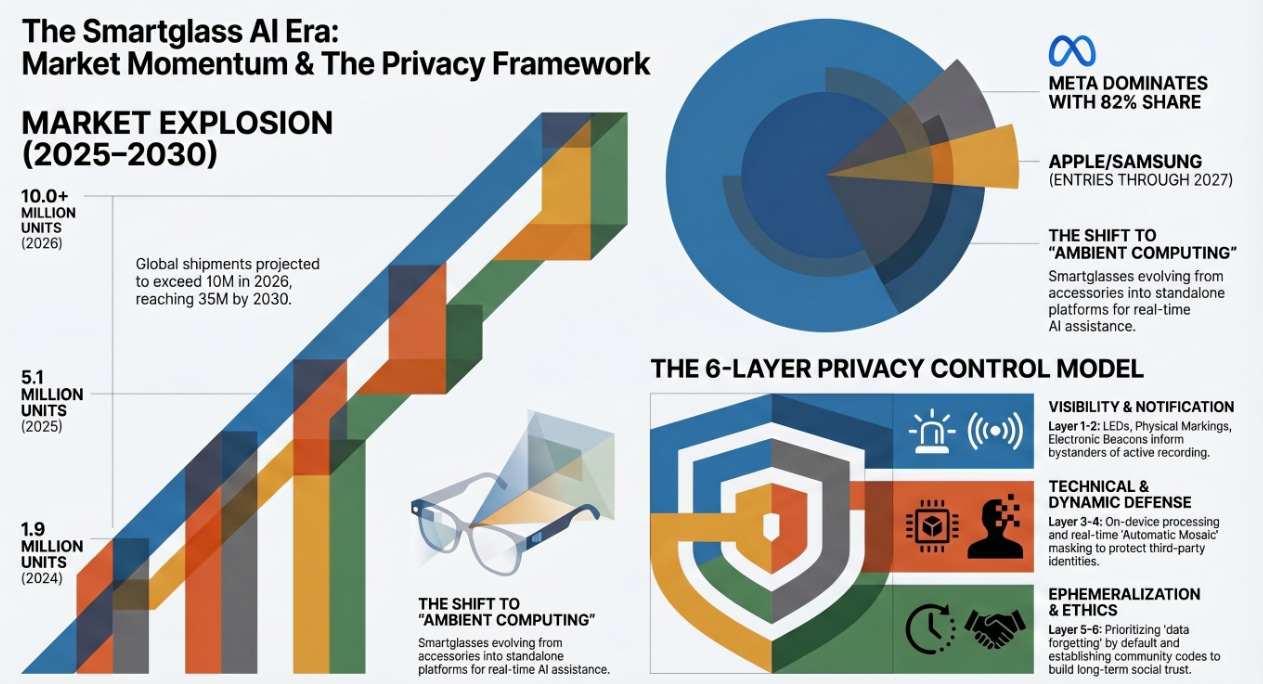
The wearable tech scene is getting a massive glow-up, and it looks exactly like your favorite pair of shades. AI-powered smart glasses shipments just skyrocketed by an insane 322% in 2025, hitting 8.7 million units. Thanks to major upgrades in AI and way lighter designs, smart glasses are officially crossing over from “tech bro gadget” to a mainstream must-have.
The big tech players are racing to build what they think will be the next smartphone.
The 2025 Wearables Boom
In 2025, global shipments for things like smartwatches and earbuds grew 9.1%, reaching a staggering 611.5 million units. But the real plot twist happened in the extended reality (XR) space, where device shipments jumped 44.4%, but traditional VR headsets actually saw a drop in sales. The entire surge was driven by sleek, display-less smart glasses. People do not want to be isolated in a headset anymore; they want hands-free cameras, audio, and AI assistants built into glasses they can actually wear in public without looking weird.
Meta is Running the Show
Right now, Meta is absolutely dominating. They captured a massive 85.2% of the global AI glasses market in 2025, shipping around 7.4 million units.
The second-gen Ray-Ban Meta glasses, a partnership that has been the game differentiator, look like classic Wayfarers but pack serious tech. You can snap photos, record TikToks, listen to Spotify, and talk to Meta AI without ever touching your phone. The company thinks these glasses could eventually replace our phones entirely. They even just dropped new prescription-ready models for $499.
Apple gets ready
You knew Apple wasn’t going to sit this one out. Leaks suggest Apple is currently testing four different frame styles for its own smart glasses, including a sleek design similar to the ones CEO Tim Cook wears.
Code-named “N50,” Apple’s glasses are expected to skip the built-in display and focus on premium materials like acetate. They will act as the ultimate iPhone accessory, using cameras and sensors to feed real-world info to an upgraded Siri. Expect an official announcement sometime in late 2026 or early 2027.
The Android Squad and Global Rivals
The China Surge: Mainland China is the fastest-growing market for AI glasses right now. Brands like Rokid and Xiaomi are dropping affordable, feature-packed glasses and quickly climbing the global ranks.
Google & Samsung: The Android XR ecosystem is waking up. Google and Samsung are reportedly teaming up for a 2026 smart glasses launch. Google even partnered with Warby Parker, copying Meta’s eyewear-brand strategy.
Snapchat is Back: Snap is partnering with Qualcomm to drop the next generation of their Spectacles AR glasses.
The era of wearable AI is officially here. Omdia predicts global shipments will blow past 15 million units in 2026. The race to replace the smartphone is happening right before our eyes.
🧰 AI Tools of The Day
AI-powered mobile app builders.
Rork - Create native mobile apps by chatting with AI. Idea to phone in minutes, to App Store in hours
A0.dev - Describe what you want in natural language, and the platform generates a complete React Native project using Expo. That includes the component tree, navigation, styling, and configuration files.
Bolt.new - Runs entirely in your browser. It focuses heavily on web applications, but it gives you direct access to the underlying code and terminal right in the browser.
AI Top 20 Tools Playbook 2026 - 20 Essential Tools for Small Business
The 20 essential AI tools for small businesses in 2026, curated and written by our team. Just honest, opinionated takes on the tools that actually move the needle.
The Trillion-Dollar Vibe Coding Race: Hype, Layoffs, and the Future of Software
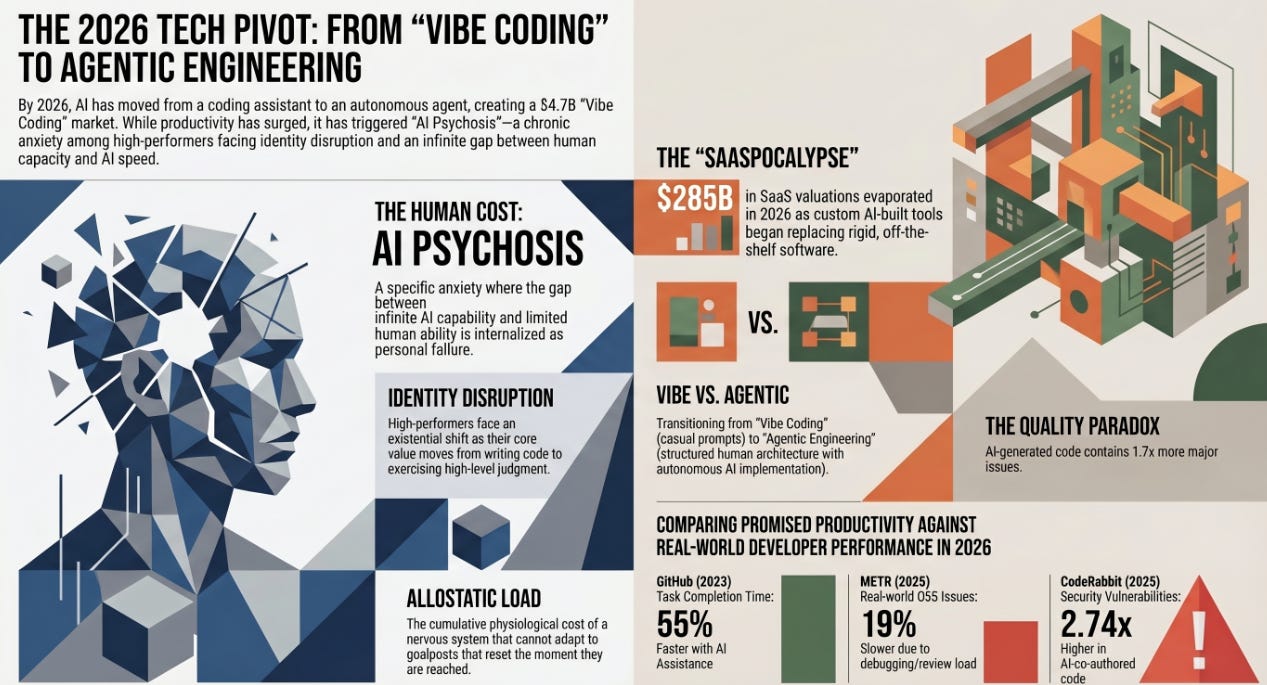
“Vibe coding, ”the act of building software by simply describing what you want to an AI, has gone from a quirky internet phrase to a multi-billion-dollar arms race. But as valuations soar and new features drop weekly, a darker narrative is emerging: mass tech layoffs, developer burnout, and existential dread over the future of the coding profession.
The Contenders: A Stack, Not a Monopoly
Industry watchers expected a “winner-take-all” scenario. Instead, developers are assembling a composable AI coding stack, layering different tools for orchestration, execution, and review.

Cursor (The Orchestrator): Valued at a staggering $29.3 billion, Cursor is the control center. Its new “Agents Window” lets developers manage fleets of parallel AI agents across local machines and cloud sandboxes.
Claude Code (The Executor): Anthropic’s terminal-based tool is the developer's favorite for actually writing the code, boasting a 46% “most loved” rating. It excels at nuanced reasoning across long context windows.
OpenAI Codex (The Reviewer): OpenAI is fighting back with a unified Codex “superapp” and a new “Scratchpad” feature for parallel tasks. They even released an official plugin that installs directly inside Claude Code, allowing developers to use Claude to write code and Codex to review it.
Lovable & Replit (The Builders): These platforms are democratizing software creation for non-technical users. Lovable hit $400 million in annual recurring revenue (ARR) at a $6.6 billion valuation. Replit recently raised $400 million, tripling its valuation to $9 billion, and launched “Agent 4” for autonomous building.
The Hype vs. The Reality
Vibe coding compresses timelines and lets solo founders ship products that previously required entire teams. But the honeymoon phase is ending.
Developers are discovering that while AI optimizes for immediate correctness, it struggles with software architecture. As one developer noted, “I am trying to fix a Vibe-coded application... the overall application is a dog’s breakfast of spaghetti” . 74% of developers feel more productive, but AI-generated code reportedly contains 1.7x more critical bugs.
Layoffs, Burnout, and “AI Psychosis”
The rise of these tools coincides with a brutal labor market. Nearly 245,000 tech jobs were cut globally in 2025, and Q1 2026 saw over 50,000 more. Tech CEOs are increasingly pointing to AI efficiencies as a justification for leaner teams.
This has created palpable anxiety. Junior developers face a hollowing out of entry-level roles. Even senior developers are grappling with the psychological toll. While some report that AI has “re-ignited a passion” for coding, others feel they are losing their fundamental skills. “If you don’t use it, you’re going to lose it,” warned one software engineer.
Furthermore, the sheer speed of AI-assisted development is leading to burnout. Developers report that managing swarms of AI agents is exhausting their “internal buffers” and disrupting sleep cycles, a phenomenon some are dubbing “AI Psychosis”.
Who Wins the Race?
The AI coding market is projected to reach $12.8 billion in 2026. But the winner isn’t a single company; it’s the composable stack.
The role of the software engineer is fundamentally shifting. The job is moving from writing lines of code to architectural design, prompt engineering, and managing fleets of AI agents. As one veteran coder put it: “AI coding still requires our expertise to guide it. I’m not sure if that will be the case in a year, but it is today”.
📚Learning Corner
Lovable Tutorial: How to Build an App Step by Step (NXCode) - A complete beginner’s guide to building a full-stack app, connecting a database, and deploying it.