

Technology can be great at solving problems, and apps that help find missing persons due to the earthquake in Venezuela are a testament to this. When the government in this South American nation stalled. coders vibe coded apps to help families find their loved ones. We will share about these apps and how it has worked. But not all technology benefits everyone, and AI has increased the financial gaps in many communities and added to labor discrepancies. Many of us fear losing our jobs due to being replaced by this tech, while others are infuriated that is only enriching the already wealthy. Some of these frustrated individuals have taken it into their own hands to get justice, which has executives shaking. But the advancements do not stop, and Mira Murati and her company, Thinking Machines, have just unveiled an amazing open model, which is rare for a US company, that has everyone talking about it. Let’s dive in and explore what all of this means. Stay curious, and have a great weekend!
📰 AI News and Trends
Why are Tech Executives Fearing for Their Lives?
What is this New Open-Weights Model by Thinking Machines?
🧰 AI Tools - AI & Tech in Crisis Response
When the Government Stalls, Citizens Code - AI in Disaster Relief
📚 Learning Corner
📰 AI News and Trends
ASML has room to raise prices, and they will.
Anthropic moves closer to mega-IPO as bankers line up investor meetings
How OpenAI’s Sol Finally Learned Design Taste
Apple has received key approval in China that paves the way for the release of its Apple Intelligence on-device AI service in the country
DeepSeek’s Annualized Revenue Nears $500 Million, Boosting Fundraising and IPO Plans
Elon Musk quietly buys a $1 billion gas turbine company to power Grok
Hack Reveals Suno AI Music Generator Scraped YouTube, Deezer, and Genius
Moroccan intelligence insider reveals widespread use of Pegasus hacking software
Nvidia Releases New Robotics AI Model
A New Open-Weights Model by Thinking Machines
Thinking Machines has just released Inkling, a powerful new 975B-parameter Mixture-of-Experts foundation model that natively reasons across text, images, and audio.
Designed as a broad, balanced generalist rather than a narrow benchmark-chaser, Inkling excels at agentic coding, tool use, and controllable thinking effort, allowing developers to balance performance with cost and latency. Because its full weights are open, it serves as an excellent base for customization. You can start experimenting with it right away by chatting with the model in the new Inkling Playground on the Tinker console, or you can begin fine-tuning it for your specific use cases directly on the Tinker platform today.
When the Government Stalls, Citizens Code - AI in Disaster Relief
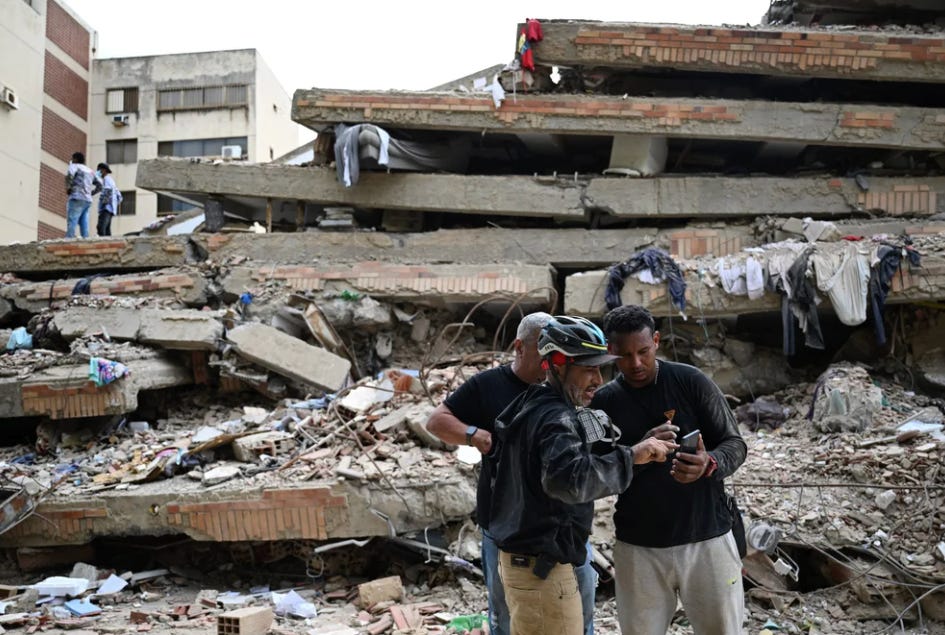
After twin earthquakes devastated northern Venezuela last month, the state’s response was agonizingly slow, but citizen developers stepped into the void. Armed with AI tools like Claude and Replit, volunteers from the Venezuelan diaspora rapidly spun up emergency response platforms in mere hours. These grassroots tools included “Desaparecidos Terremoto Venezuela”, which used AI and donated facial recognition software to process over 30,000 missing-person reports in two days, and “Ayuda en Camino”, a logistics hub built in four hours that used a WhatsApp assistant to coordinate donations in low-connectivity areas.
While experts warn that these AI-driven, citizen-led initiatives require robust data privacy measures and cannot permanently replace state accountability, they have undeniably democratized crisis response, proving that when institutions fail, communities can use AI to save lives.
🧰 AI Tools of The Day
AI & Tech in Crisis Response
If the Venezuela story caught your eye, here are 4 established apps and platforms that use AI and crowdsourced tech to coordinate disaster relief and find missing persons globally:
1. AIDR (Artificial Intelligence for Disaster Response) - A free and open platform developed by the Qatar Computing Research Institute. AIDR uses machine learning to filter and classify massive volumes of social media messages during emergencies, helping humanitarian organizations pinpoint exactly where aid is needed in real-time.
2. Ushahidi - Originally developed to map reports of violence in Kenya, Ushahidi is now a gold-standard open-source platform used in over 30 countries. It crowdsources crisis information, allowing citizens to report incidents via SMS, email, or web, and maps the data to empower rapid community response during natural disasters.
3. Google Person Finder - An essential web application activated during major crises. It serves as an open-source registry and message board for survivors, families, and emergency responders to post and search for the status of missing loved ones.
4. Zello - While not strictly AI, Zello is a vital disaster-response tool. It turns smartphones into walkie-talkies (push-to-talk) and operates effectively on low-bandwidth networks. It is widely used by volunteer rescue fleets (like the “Cajun Navy” during hurricanes) to coordinate real-time logistics when traditional communications infrastructure fails.
Why are Tech Executives Fearing for Their Lives?
A wave of violent threats, and at least one serious real-world attack, is targeting AI company executives and their properties. The most alarming incident was an attempted firebombing of OpenAI CEO Sam Altman’s home in April 2026, carried out by a Texas man who was later charged with attempted murder and attempted arson. Police found a manifesto on him explicitly calling for the killing of AI CEOs and investors. Around the same time, a man tailgated his way into Anthropic’s lobby, claiming an executive “was going to be killed.” A third man threatened to show up at Anthropic’s office with a pistol over a billing dispute. According to the threat intelligence firm Liferaft, the volume of digital threats targeting AI executives and data centers grew sevenfold between late February and May 2026.
Why Are People Threatening Them
The anger is rooted in a deep and growing fear that AI is dismantling livelihoods and concentrating power in the hands of a tiny elite, which is true. Three overlapping grievances are driving the backlash:
Job loss. Companies are openly attributing layoffs to AI-driven efficiencies. When Meta announced ~1,400 layoffs in Washington state during an AI pivot, online commenters called for Zuckerberg’s yacht to be sunk or blown up. A laid-off Pinterest designer captured the sentiment bluntly: “You can’t go back to serfdom. It really feels like the people in power want to be kings.”
Economic anxiety. Ordinary people blame AI companies for rising rents, high energy costs, and a broader sense that the technology is being imposed on them without consent or recourse.
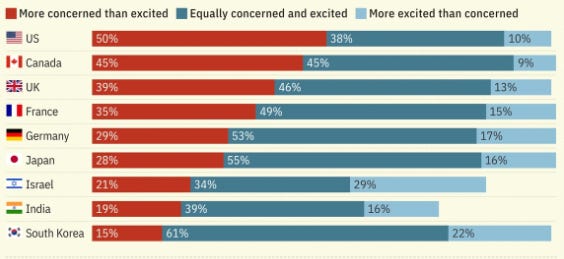
Powerlessness and alienation. Palantir CEO Alex Karp acknowledged at a conference that when people are told “your job is going to disappear,” they “go for the pitchfork.” A Quinnipiac survey from March 2026 found that Americans concerned about AI outnumber those who aren’t by more than 4 to 1, and 55% believe AI is doing more harm than good.
How Executives Are Protecting Themselves
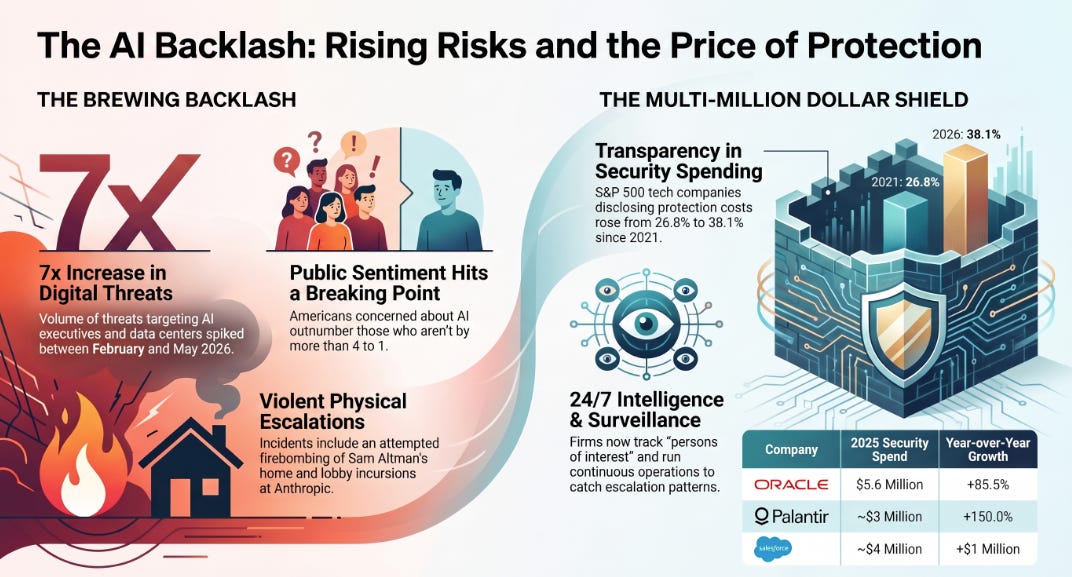
Across the S&P 500 tech sector, the share of companies disclosing executive protection spending jumped from 26.8% in 2021 to 38.1% in 2025. Specific measures include: traveling with armed guards (though tech execs prefer low-profile, “slender” security over conspicuous bodyguards), running 24/7 security operations (Anthropic has done so since 2024), tracking “persons of interest” to catch escalation patterns early, and discouraging employees from wearing company logos in public to avoid being targeted. Some executives have also gone quieter on AI’s risks to jobs, pivoting their public messaging toward its potential benefits.
The main issue is how the industry that is simultaneously accelerating its most disruptive technology and grappling with the social fallout it is generating, is dealing with the situation. Karp put it starkly: “None of us are going to make any money when the country blows up.” The tension between the enormous financial incentives pushing AI forward and the mounting public fury at its human costs is, for now, unresolved — and the executives building these systems are increasingly living with that contradiction behind armed guards.
The shift toward community-driven AI in disaster response highlights how essential accessible visual computing has become. When satellite feeds, on-the-ground photos, and damaged maps need rapid cleanup or enhancement, having an accessible ai image editor at https://imgtoimg-ai.com/ai-image-editor allows volunteer teams to quickly process visual data without relying on bulky desktop pipelines.