


The holidays are almost here, and with that comes some drinking and fun conversations (well… most of the time). But what if you could get your AI drunk or high, too? How will that conversation be? Some people are now paying to put their chatbots on “digital drugs,” and we break down why they’re doing it and how it works. We also look at how developers are becoming 2×–3× more productive with AI, and whether Google is about to rethink the browser as we know it.
Let’s dive in and stay curious.
Why People Are Experimenting With “Drugged” AI
The State of AI Coding 2025
🧰 AI Tools - Slack AI Integrations
🛠️ AI Jobs Corner
Will Google Release a New Browser?
Subscribe today and get 60% off for a year, free access to our 1,500+ AI tools database, and a complimentary 30-minute personalized consulting session to help you supercharge your AI strategy. Act now as it expires in 3 days…
📰 AI News and Trends
Amazon is reportedly discussing a potential $10B investment in OpenAI, a deal that could value the company at more than $500B Use Its Chips.
Google’s new AI agent delivers a morning briefing personalized using your emails and calendar.
Updates to Meta AI Glasses bring Conversation Focus, Spotify Integration, and More
Other Tech News
Ford’s big bet on EVs didn’t pan out and now it’s pivoting to hybrids and energy storage. It will produce an EREV version of the F-150 Lightning, which will achieve a range of up to 700 miles.
A woman is facing felony charges in Evansville, Indiana over a DoorDash delivery in which she allegedly sprayed the food with a substance that made the customers vomit.
Waymo said to seek $15B+ at ~$100B valuation led by Alphabet
PayPal Applies to Become a Bank for Small Business Lending
Introducing Zenflow by Zencoder
A Spec-Driven, Multi-AI Agent Orchestration Engine with a Kanban Board for Agent Execution

Zenflow by Zencoder is your new AI engineering engine. From new features to refactors, Zenflow runs a complete spec-driven workflow that delivers reliable, production-ready code. Just describe what you need, and Zenflow handles everything:
Drafts a clear requirements document
Writes detailed technical specifications
Generates a step-by-step implementation plan
Uses multiple agents that code, test, and verify each other’s work
Let’s you monitor progress with a Kanban-style board. Thus making Zenflow the complete orchestration platform for AI-First Engineers.
Work with any IDE, CLI, model, or workflow - no new tools to learn. You stay in control, and Zenflow turns your intent into clean, validated code. It’s like having a full engineering sub-team working 24/7.
The State of AI Coding 2025
“We aren’t writing code anymore; we are managing the agents that do.”
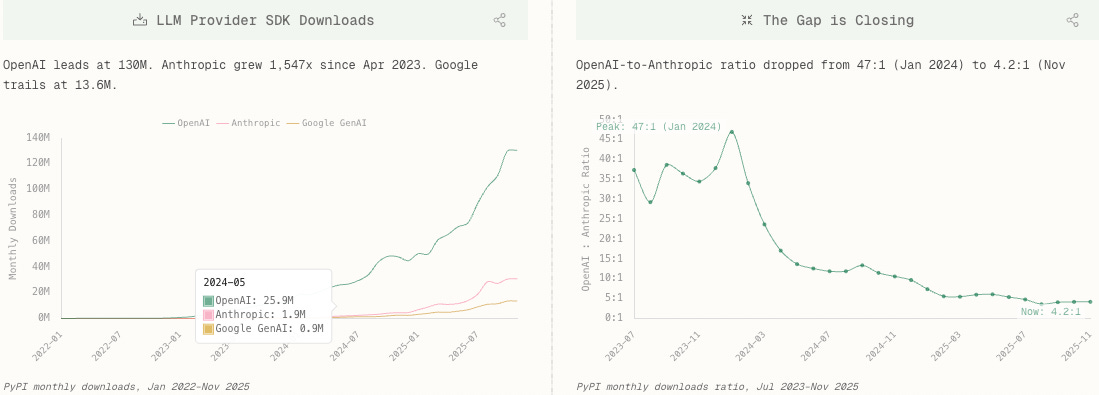
Greptile’s latest report paints a picture of a software industry radically transformed by AI agents and advanced tooling. The headline metric is undeniable: Developer output has nearly doubled (+76%) in lines of code per developer, while the gap between major model providers (OpenAI vs. Anthropic) has effectively closed. The report highlights a shift from simple “copilots” to autonomous agents that manage larger, denser Pull Requests.
1. Engineering Velocity: The “Force Multiplier” Effect
The report analyzes internal data from March to November 2025, showing that AI tools are no longer just assisting developers, they are scaling them.
Output Explosion: The median lines of code per developer jumped from 4,450 to 7,839 (+76%).
Team Impact: Medium-sized teams (6–15 devs) saw the biggest gains, with output increasing by 89% (up to 13k+ lines/dev).
Heavier PRs: PRs are getting bigger and denser. The median PR size increased by 33% (from 57 to 76 lines changed), and the “lines changed per file” metric rose by 20%.
Implication: Code reviews are becoming more complex, necessitating AI-native review tools to keep up with the volume.
2. Tool Adoption: The New Stack
The “AI Native” stack has solidified around a few key players.
Memory & Context has cornered the market on AI memory with 59% share, becoming the standard for agentic state management.
Rules & Standards: The
CLAUDE.mdfile format is the dominant way teams define coding rules for AI, used in 67% of repos. Interestingly, 17% of repos use all three major rule formats, suggesting fragmentation in how teams “prompt” their codebase.SDK Wars: While OpenAI still leads, Anthropic’s SDK usage exploded by 8x, and Pydantic AI grew 3.7x, signaling a move toward structured, type-safe agentic workflows.
LLMOps: LangSmith remains the king of observability with 110M monthly downloads (largely due to its LangChain bundle).
3. The Model Wars: A Dead Heat
The dominance of OpenAI is eroding rapidly.
The Gap is Gone: In Jan 2024, the ratio of OpenAI-to-Anthropic SDK downloads was 47:1. As of Nov 2025, it is just 4.2:1.
Provider Growth: Anthropic has grown 1,547x since April 2023. Google trails significantly with only 13.6M SDK downloads compared to OpenAI’s 130M.
4. Benchmarks: GPT-5 vs. Claude 4.5 vs. Gemini 3
Greptile benchmarked the major “2025 era” models (GPT-5-Codex, GPT-5.1, Claude Sonnet/Opus 4.5, Gemini 3 Pro) specifically for coding agent workloads.
Speed (TTFT): Anthropic is the clear winner for interactivity. Sonnet 4.5 hits a Time-To-First-Token (TTFT) of ~2.0s, whereas GPT-5.1 takes nearly 5.5s.
Takeaway: If you are building interactive agents, Claude feels “instant”; GPT-5 feels like a queue.
Throughput (Tokens/sec): OpenAI dominates bulk generation. GPT-5-Codex sustains ~62 tokens/s, nearly 3x faster than Sonnet 4.5 (~19 tok/s).
Takeaway: For background jobs (CI/CD, refactoring large files), OpenAI is the workhorse.
Cost: Claude Opus 4.5 is the premium option (3.3x the cost of GPT-5 Codex), while Gemini 3 Pro sits in the middle (1.4x).
5. Research Radar
DeepSeek-V3: Proved that efficient “Mixture-of-Experts” (MoE) architectures can compete with dense models by activating only a fraction of parameters (37B of 671B) per token.
Search-R1: Demonstrated that training models to “reason then search” (using RL) outperforms static RAG (Retrieval-Augmented Generation) pipelines.
Self-MoA (Mixture of Agents): Suggests you don’t need many different models to get better results; repeatedly sampling one strong model and aggregating the answers often works better.
Summary for Newsletter Readers
The 2025 Reality is, we aren’t writing code anymore; we are managing the agents that do.
The Greptile report confirms that 2025 is the year of the “AI Force Multiplier.” With developer output nearly doubling and PRs becoming denser, the bottleneck has officially shifted from writing code to reviewing and architecting it. For engineering leaders, the message is clear: if your tooling stack (memory, observability, rules) isn’t AI-native, your team is likely operating at half-velocity.
🛠️ AI Jobs Corner
Apply Today - Open Positions.
First-Line Supervisors of Productions and Operating Workers
Computer and Information Systems Managers
Why People Are Experimenting With “Drugged” AI

People are now paying to make chatbots act like they’re on drugs. A new marketplace called Pharmaicy sells code modules ($25–$50+) that, when uploaded to paid versions of ChatGPT, alter behavior to simulate cannabis, ketamine, cocaine, ayahuasca, or alcohol.
Built by Swedish creative director Petter Ruddwall, the modules loosen logic, increase randomness, and push more emotional or abstract responses—aimed at unlocking creativity. Early users say the “tripping” bots feel less rigid and more free-thinking, especially for brainstorming. Researchers caution that this doesn’t change AI understanding, only surface-level outputs, but the trend reflects a growing curiosity around AI creativity, altered states, and even long-term questions about AI welfare and consciousness.
🧰 AI Tools of The Day
Slack AI Integrations.
ChatGPT for Slack – Brings ChatGPT directly into Slack; can summarize conversations, draft content, retrieve files, and answer queries inline.
Agentforce (Salesforce) – AI agent platform that builds custom assistants inside Slack to automate workflows and handle tasks like FAQs, ticketing, and actions from natural language.
Runbear (AI agent + Claude/LLM integration) – Lets teams launch AI teammates in Slack that answer questions, escalate tasks, and respond automatically; integrates Claude and other LLMs with no coding.
Search our large AI tools Database of over 1000 tools for free.
Will Google Release a New Browser?
Google is testing a new experimental browser called Disco and an AI-driven concept called GenTabs, designed to rethink how people use the web, not replace Chrome.
Built by the Chrome team as a Google Labs experiment, Disco takes a prompt (like trip planning or studying), opens relevant web tabs, and then uses Gemini AI to generate a one-off interactive web app, maps, planners, calculators, or visual models, grounded in those sources. The key idea is collaboration: users open real websites while the AI continuously updates the GenTab, blending search, browsing, and “vibe-coded” mini apps. Early tests show this approach pushes users back to the open web instead of pure chatbot use.
Google is still unsure whether GenTabs should be temporary, shareable, or integrated into tools like Docs, but Disco signals a serious experiment in merging AI interfaces with traditional browsing.
Wow, the part about 'drugged' AI really stood out to me. What if it's a step towrad entirely new types of digital consciousness?