

Greetings everyone, we took a little break while I was visiting family members and friends in Europe. We were fortunate enough to visit Paris, Biarritz, and other cities in the South of France, San Sebastian in Northern Spain, and the UK. It is always great to see how much cities change. The last time I had the chance to visit that area was more than 15 years ago, and things are really different. I was there during the fires that ravaged France and Spain, and I have to admit these heat waves followed by uncontrollable fires are very new to the area. But, hey, some say there is no global warming. Besides that, everything was positive, compared to other places on this side of the globe. I love how many bike lanes and bike sharing services are in those cities, the public transportation infrastructure, the coffee shops and coffee vending machines (lol, I owned one, so I was paying attention), the amount of people reading actual physical books, the diverse population that always makes great conversation and learning experiences, and overall the way traveling opens your brain. But now we are back and excited to write and share.
One of the last newsletters I published shared content about the role of AI in disaster relief right after the Venezuela earthquake. Today, we are following the Colombian 7.4-magnitude quake that struck 3 days ago, killing ~265 people, and around 500 others are still missing. Technology is playing a big role in helping find those under the rubble and locate loved ones alongside rescue dogs and the irreplaceable human brain, creating A layered system
No single technology can reliably find everyone. Instead, rescuers combine dogs → thermal drones → acoustic/physical detection → human verification → and heavy equipment. AI can increasingly sit above that stack, analyzing imagery, identifying damaged structures and prioritizing locations for human teams.
Finding someone isn’t the same as reaching them. A thermal camera may identify a possible survivor, but rescuers still have to determine whether the signal is actually human, stabilize the structure and safely extract the person. Hence why human rescue specialists remain at the center of the operation.
The window is also closing. The critical 48–72-hour period for finding survivors has now passed; people can survive longer under rubble when they have access to air, water, or other favorable conditions, but the point is to have and utilize the right tech to speed up the finding and rescue process. The future isn’t an AI robot replacing the rescue worker, but an AI-enabled rescue team that can search more territory dramatically, identify the highest-probability locations, and put human rescuers where they have the greatest chance of saving a life.
In today’s issue:
📰 AI News and Trends
The Never-Ending Cycle of AI
The debate over open vs. closed AI
🧰 AI Tools - AI & Tech in Crisis Response
📚 Learning Corner
📰 AI News and Trends
AI Agents Are Taking Over Enterprise Work, But Most Companies Are Still Behind
Talking to your phone has long been a convenient alternative to typing. With the Pixel 11, Google is extending that option to people who communicate through Sign Language (ASL).
The viral story of an Australian entrepreneur using ChatGPT and other AI tools to create a personalized mRNA vaccine for his dog has now turned into Gamgee, a YC-backed startup developing personalized cancer vaccines for dogs.
Apple seeks publisher deals to give Siri AI better access to current events
Google updates Pixel lineup with new phones, foldable, watch
Taiwan’s Foxconn reports 35% rise in Q2 profit on AI demand, beats forecasts
Lovable confirms new $13.3B valuation, raises another $400M
The Never Ending Cycle of AI
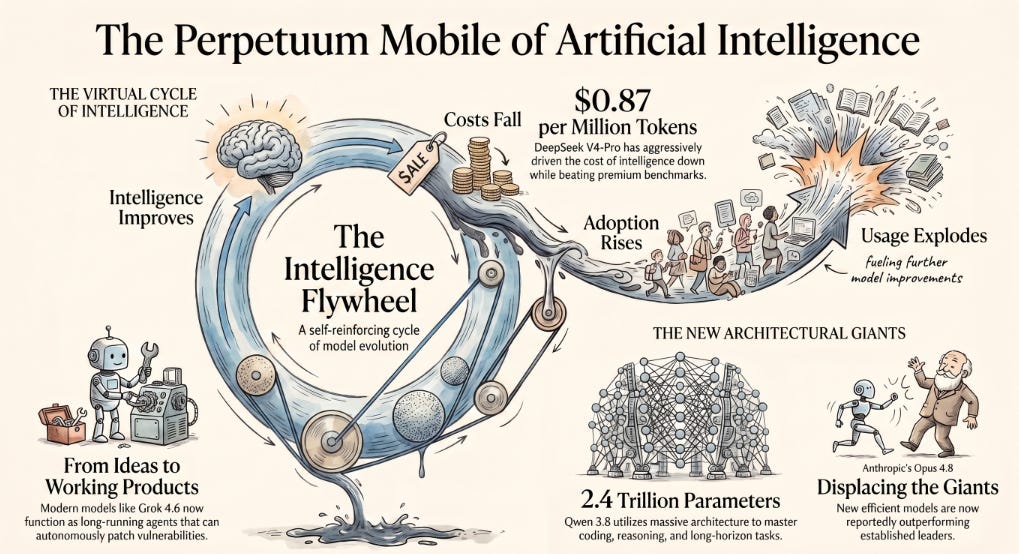
The AI race is becoming a self-reinforcing loop. Models are getting smarter, cheaper, and more autonomous at the same time.
The recently released, xAI’s Grok 4.6 is pushing toward long-running agents that can turn ideas into working products and even patch vulnerabilities; The official version of DeepSeek V4-Pro is driving the cost of intelligence down to just $0.87 per 1 million output tokens while reportedly beating Anthropic’s Opus 4.8 on several agentic benchmarks; and Qwen3.8, with a massive 2.4-trillion-parameter architecture, is improving coding, reasoning, and long-horizon task execution.
These advances reinforce one another: better models enable more capable agents; agents generate more AI usage; greater usage drives demand for cheaper inference; and cheaper inference makes increasingly powerful models available to more developers. The result is a cycle that appears far from finished—intelligence improves → costs fall → adoption rises → usage explodes → models improve again.
📚 Learning Corner
The debate over open vs. closed AI
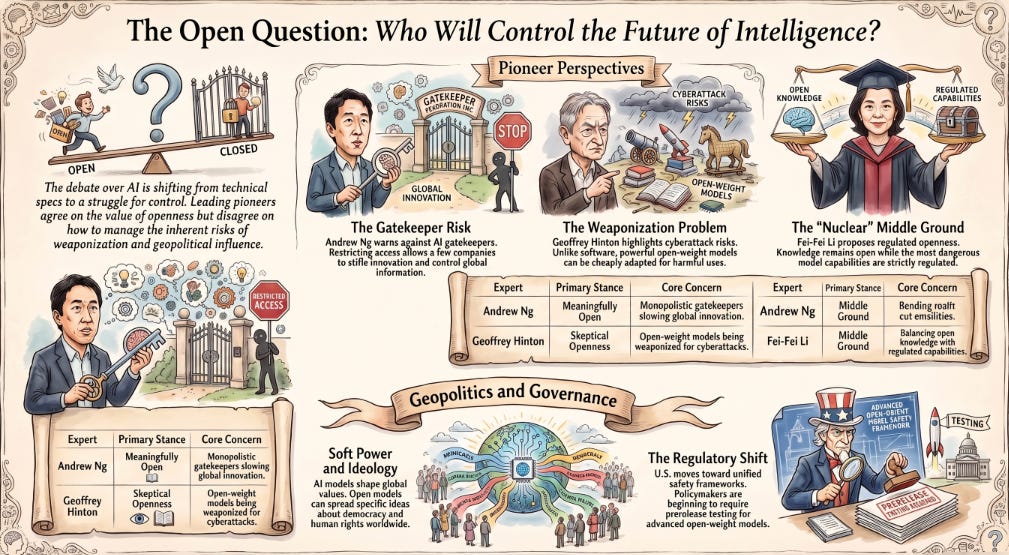
The debate over open vs. closed AI is becoming less about technology and more about who controls the future of intelligence.
At an AI4 conference, AI pioneers Geoffrey Hinton, Fei-Fei Li, and Andrew Ng all argued that AI should remain meaningfully open, but for different reasons. Ng warned that allowing a few companies to become AI gatekeepers could slow innovation and give them enormous influence over what billions of people can access.
Hinton agreed that open AI has benefits but warned that open-weight models are fundamentally different from open-source software because powerful models can be cheaply adapted for cyberattacks and other harmful uses, and, in his view, that battle is already lost. Li argued for a middle ground, comparing AI to nuclear science: knowledge can remain open while the most dangerous capabilities are regulated. The stakes are also geopolitical: Ng warned that cheaper Chinese open models could spread across developing markets and become a form of soft power, shaping how billions of people interact with ideas about freedom, democracy, and human rights.
Meanwhile, the U.S. government is moving toward bringing open-weight AI under the same safety framework as closed frontier models, potentially requiring prerelease testing once open models reach capabilities comparable to the most advanced systems, showing how quickly AI’s accelerating capabilities are forcing policymakers to rewrite the rules in real time.
The emerging consensus is therefore not “open or closed,” but how much openness each layer of AI should have, and who gets to decide.
🧰 AI Tools of The Day
AI & Tech in Crisis Response
🚁 Thermal-imaging drones - DJI Matrice 4T / Search & Rescue
DJI’s enterprise drones combine thermal imaging, AI-assisted detection, low-light cameras, and mapping for search-and-rescue operations. DJI says the Matrice 4T can be deployed rapidly and uses thermal sensing to locate people in difficult conditions.📡 Life-detection radar — Camero-Tech Xaver Life Detection Systems
These systems use ultra-wideband radar to detect movement and breathing through walls and rubble, allowing rescuers to determine whether someone may be trapped even when they cannot see or hear them.🛰️ Satellite imagery + AI mapping — Maxar
Maxar combines high-resolution Earth-observation imagery with AI-powered geospatial analysis to rapidly map disaster damage, infrastructure, and affected areas.